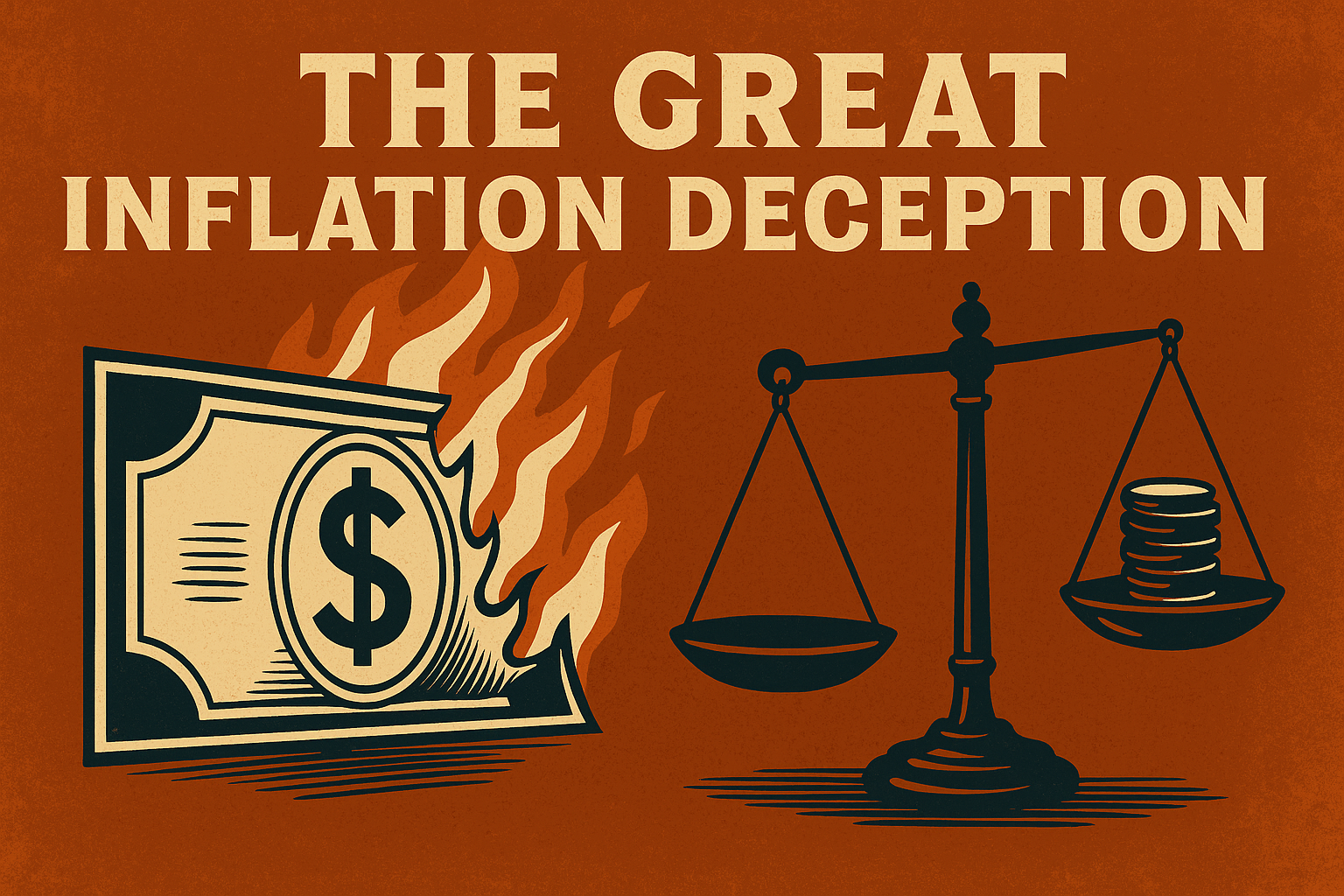
Wrong About Inflation: The Great Money Deception
The Lie You’ve Been Told
We’ve been lied to about inflation. The word itself is a magician’s trick—a sleight of hand that hides the real culprit. Most people believe inflation simply means that prices are rising. If groceries, gas, and rent all cost more, then someone must be greedy, right? Companies, landlords, and unions must be raising prices for selfish reasons.
That is the deception. The term inflation protects the guilty and blames the innocent. The guilty are those who manipulate the money supply—governments and central banks. The innocent are ordinary citizens, small businesses, and workers who lose purchasing power year after year.
Prices don’t rise on their own. They rise because money falls.
Inflation Is a Symptom, Not a Cause
Blaming prices for rising prices is like blaming the fever for the infection. Inflation is only the symptom. The true cause is monetary devaluation—when more money is created without a matching increase in goods and services.
If I sow bad seed in the spring, I don’t discover my mistake until harvest. Likewise, when governments flood the economy with cheap money, the bitter harvest—higher prices—arrives years later. By the time voters feel the pain, the policymakers have already moved on or been re-elected. Inflation is the delayed consequence of monetary sin.
The Root Cause: Expanding the Money Supply
Every bout of inflation begins the same way: someone creates new money faster than new goods can be produced.
Deficit Spending
When the government spends money it doesn’t have, it borrows from the future and floods the economy with new dollars. Those who first receive the new money—the government and its contractors—spend it at full value. But as that money filters through the economy, it loses value. By the time it reaches you and me, prices have already adjusted upward.
This process rewards the powerful and punishes the prudent. It is moral inversion—the first spenders gain, the last spenders lose.
Quantitative Easing
Quantitative easing, or QE, is the modern version of printing money. Central banks create digital dollars and give them to commercial banks to “stimulate the economy.” The banks use this new money to buy assets—bonds, houses, stocks. With all that cheap money chasing limited goods, prices soar. The flood of new money drives up the cost of everything, from homes to food.
By the time the money reaches workers’ paychecks, it has already been diluted. Wages rise more slowly than prices. The result is that every paycheck buys less. Inflation is not a natural disaster—it’s a policy decision that punishes the careful and rewards the well-connected.
What Happens to Ordinary People
We, the people, are not the money-makers; we are the money-takers. We receive the diluted dollars after the powerful have already spent theirs. The value has already drained away, leaving only the higher prices behind.
They reap first. We pay last. That’s inflation.
The system is designed so that every new dollar steals a fraction from every existing one. The slow theft continues year after year until savings vanish, trust erodes, and the middle class thins.
Spain and the Flood of Gold
History has seen this before. In the 1500s and 1600s, Spain’s empire brought home shiploads of gold and silver from the New World. Gold was still gold—but there was suddenly much more of it. Prices across Spain exploded. The nation grew rich in appearance but poor in substance. Too much money chased too few goods, and the value of money fell.
Five centuries later, we repeat Spain’s mistake—not with galleons of gold, but with digital printing presses. Even honest money, when multiplied too quickly, destroys balance.
Learn to Play the Game
It would be comforting to believe justice will soon prevail, but God allows the rain to fall on the just and unjust alike. Wisdom lies in knowing how to endure the storm.
Modern currency is fiction—paper and digits that hold value only by agreement. Learn the rules. Play the game wisely. Own real goods, build productive skills, and reduce dependence on paper promises. This is the beginning of financial wisdom—the practical side of The Alpha Strategy.
Unjust Weights, Unjust Times
In ancient marketplaces, dishonest traders used two sets of stones—one for buying and another for selling. God called this an abomination because it robbed others by deceit.
Today, we no longer weigh silver or grain, yet our governments and banks still tamper with the scales. When they create new money from nothing, they change the measure of value by which every trade is made. The numbers in our accounts may rise, but their worth shrinks. This is false weights and measures in digital form.
Inflation is not just an economic inconvenience—it is a moral corruption. It rewards deceit and punishes diligence. It is theft by dilution: quiet, legal, and universal. Each year of devaluation steals a little more from the widow, the worker, and the saver who trusted that money would hold its value.
If we care about justice in trade, we must care about honest money. The Bible’s warnings are not ancient economics—they are timeless moral law.
To explore this further, see the companion article below.
Inflation: An Abomination to God
“A false balance is an abomination to the Lord, but a just weight is his delight.” — Proverbs 11:1
“You shall have just balances, just weights, a just ephah, and a just hin.” — Leviticus 19:36
In God’s design, money is a tool of fair exchange. It measures the fruit of our labor, the value of our time, and the worth of our goods. When rulers corrupt that measure, they break faith with both God and man. They commit a sin not of mathematics but of morality.
Throughout history, false money has produced the same harvest: arrogance among the powerful, despair among the humble, and distrust throughout society. Inflation is simply the modern disguise of an ancient evil—unjust scales tilted by those in authority.
To live righteously in such a system, we must first see the deceit for what it is. Then we can practice honesty in our own dealings, store value in real and useful things, and remember that ultimate security rests not in currency but in character.
Creation Note
This article was researched and drafted by me; afterwards, ChatGPT generated the final output for this post.