A Meditation on Honest Weights, Honest Work, and the Future of Civilization
Why Inflation Is an Abomination to God
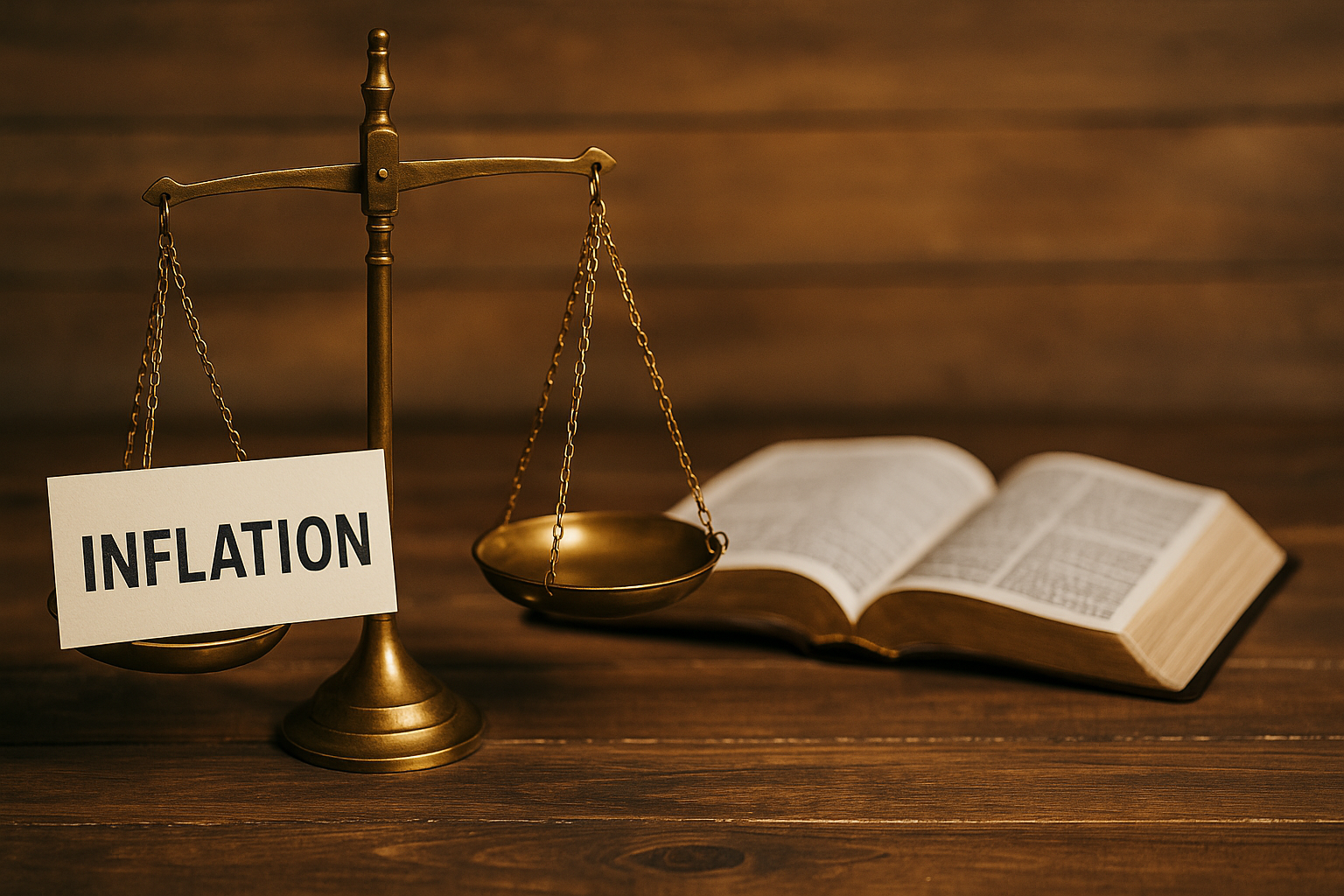
The Bible speaks with unmistakable clarity about the importance of honest weights and measures. “You shall do no wrong in judgment, in measures of length or weight or quantity,” says Leviticus 19:35–36. “A false balance is an abomination to the Lord, but a just weight is His delight” (Proverbs 11:1).
God’s anger toward unjust measures is not about the mechanics of trade. It is about truth. When people lie in commerce—when they deceive through weights, coins, or credit—they do more than steal silver. They steal trust. They destroy the moral fabric that binds a community together.
The early Church Fathers saw this clearly.
- John Chrysostom called dishonest trade “theft in slow motion.”
- Augustine described it as disordered love—preferring profit to righteousness.
- Basil the Great wrote that fair commerce is an act of practical righteousness, part of what it means to love one’s neighbor.
Throughout Scripture, God’s law protects the poor, the widow, and the foreigner from economic deceit. Honest exchange preserves dignity; dishonest exchange destroys it. When a society abandons the principle of sound measure, it undermines justice itself.
Today, our modern version of false weights is inflation—the systematic dilution of money’s value. By printing what has not been earned, governments quietly extract wealth from savers, workers, and retirees. The scale still looks balanced, but one side has been hollowed out. The result is moral inversion: those who live prudently are punished, and those who manipulate money are rewarded.
To understand how grave this is, it helps to imagine what life might look like under two futures—the world as it could be under honest money, and the world that awaits if deception continues.
The World of Honest Money: A Glimpse of Order Restored
Imagine an economy where money means what it says. A dollar today would be worth a dollar tomorrow. Inflation would not exist because governments could not counterfeit prosperity. Prices would rise or fall only as real supply and demand changed.
Such a world would not be utopian—it would simply be truthful. And truth always brings peace.
A Culture of Trust
With stable money, every exchange would once again be a covenant of fairness. A man’s wages would retain their worth; a woman’s savings would not evaporate. Contracts could be trusted. Trade would no longer be a gamble against tomorrow. The moral tone of society would lift, because its medium of exchange would be honest.
Commerce would become a daily exercise in faithfulness—a quiet reenactment of God’s command for just measures.
The Return of Long-Term Thinking
Inflation destroys patience. When value decays, people rush to spend, speculate, or borrow. But in a stable-value economy, patience would again be rewarded.
-
- Families could save for decades with confidence.
- Businesses could plan for the long term, building rather than gambling.
- Farmers could plant trees that would bear fruit for their grandchildren.
Time itself would regain meaning because the future would once again honor the past.
The End of the Speculative Casino
Without inflation, financial speculation would wither. There would be no easy profits from leverage or currency manipulation. Wealth would flow back to those who create real value—builders, farmers, inventors, teachers.
This would reawaken a culture of craftsmanship and production. The moral economy of Scripture—honest labor rewarded by honest pay—would emerge naturally once more.
Honest Government, Accountable Citizens
A government that cannot print money must live within its means. Taxes would have to be transparent; debts would have to be justified. Waste would shrink, and citizens would rediscover the link between what is earned and what is spent.
Political leaders would be forced to govern as stewards, not gamblers. Fiscal honesty would again become a form of moral leadership.
A World of Peaceful Stability
Finally, such a society would feel different. Freed from the constant anxiety of rising costs and collapsing pensions, people could once again focus on things that matter—family, worship, craftsmanship, and community.
The economy would cease to be a storm and become a tool. Civilization would breathe again.
This is not fantasy. It is simply what happens when the medium of exchange reflects truth rather than deceit—when a society aligns its economic life with the moral order of God.
The World of Dishonest Money: A Descent into Dependency
If we continue our present course—borrowing without repentance, printing without production—the outcome is certain. The logic of dishonest money is decay. It corrodes everything it touches.
The Vanishing Middle
In a system where new money flows first to banks, governments, and corporations, the working and middle classes always lose. Their wages rise last while prices rise first.
Over time, society divides into two groups: those who create money and those who chase it. The producers become servants to the speculators. The humble builder subsidizes the financier.
Endless Work for Diminishing Returns
Inflation turns life into a treadmill. Everyone must run faster each year just to stay even. Two incomes replace one. Retirement drifts away. Families delay children because they can no longer afford them.
Meanwhile, the reward for thrift disappears. Savings lose value. People, desperate to preserve wealth, gamble in markets designed to favor insiders. Work feels futile; cynicism spreads.
The Rise of Surveillance and Control
As debt deepens, governments must monitor and tax every transaction. The next logical step is digital money—programmable currency tied to identity and behavior.
Sold as convenience, it becomes control. Purchases can be tracked, restricted, or denied. Economic dependence becomes political obedience. Liberty vanishes not in an explosion, but in a quiet click.
The Moral Collapse Beneath the System
When the system itself is dishonest, virtue becomes unprofitable.
-
- Why save when inflation punishes savers?
- Why work when speculation pays more?
- Why tell the truth when the state manipulates statistics?
Dishonest money teaches a population to mimic money’s own corruption. Children grow up believing that value is arbitrary, that manipulation is normal. It is not just an economic failure—it is the death of character.
Permanent War and Permanent Debt
A state that can print money can also wage endless wars without immediate taxation. Inflation becomes the fuel of the empire. Each generation inherits new liabilities and fewer freedoms.
Eventually, collapse arrives not through invasion but through exhaustion—an empire devoured by its own paper promises.
The Hollowing of Real Production
As money loses anchor in tangible value, manufacturing declines. Bureaucracy multiplies. The economy becomes an echo chamber of speculation. When the illusion breaks—when shelves empty or power grids fail—people rediscover that you cannot print bread or electricity.
By then, skills are lost, and dependency is complete.
The Managed Population
The logical endpoint of dishonest money is total management. Prices are fixed, savings eroded, behavior monitored. Citizens become subjects.
Freedom becomes permission, granted by those who control the digital mint. Families disintegrate, faith communities shrink, and fear replaces fellowship. Society becomes peaceful in the way a prison is peaceful.
Living Wisely in a Crooked Economy
“The prudent sees danger and hides himself, but the simple go on and suffer for it” (Proverbs 22:3). We cannot repair a global system built on deceit, but we can live truthfully within it. The goal is not rebellion but resilience—prudent self-preservation rooted in faith.
Keep Your Moral Compass True
Refuse to let corruption shape your character. Live with integrity in every transaction. Practice fairness even when others do not. Remember that the true “standard of value” is moral, not monetary.
Honesty is your personal gold standard.
Live Below Your Means
Simplify life. Avoid debt. Maintain habits of repair and thrift. A modest, contented life is invisible to inflation’s theft.
True wealth is control over your time, not the abundance of depreciating possessions.
Store Value in the Real and Useful
Hold some wealth in durable forms: land, tools, metals, skills, knowledge, relationships. These are the currencies of endurance.
The wise steward converts paper into permanence—what cannot be inflated away.
Build Local and Family Resilience
Learn practical skills. Grow some food. Repair what breaks. Form alliances with honest neighbors. A network of capable families is the oldest and surest form of social security.
Joseph prepared grain in abundance, not out of fear, but obedience.
Keep Investments Productive and Understandable
If you cannot explain how something creates value, it’s speculation. Favor enterprises that make or fix something tangible. Work and invest where human need meets honest labor.
Better a small return from truth than a large one from deceit.
Anchor Security in God, Not Gold
Material prudence is wise, but ultimate safety lies in Providence. “The name of the Lord is a strong tower; the righteous man runs into it and is safe” (Proverbs 18:10).
Generosity, gratitude, and stewardship are spiritual hedges stronger than any bank vault.
Hope for the Honest and the Faithful
In times of deceit, truth becomes revolutionary. When economies crumble under their own lies, those who lived by honest measures will be the builders of what comes next.
Our hope is not in the stability of nations but in the constancy of God. He delights in fair trade, faithful stewardship, and communities that reflect His justice. Each household that lives by these principles becomes a small embassy of the Kingdom—a preview of the world to come.
When the false balances fall and the digital idols crash, the people who lived in truth will still know how to live. They will plant, build, trade, and teach again. They will rebuild the ruins with knowledge earned in hardship and guided by faith.
The wise steward, then, does not despair. He prepares. He works quietly, teaches faithfully, and guards his household from deceit. He understands that honest money is not the foundation of heaven—but it is the reflection of it.
For when God restores the earth, the economy of righteousness will return:
- Work will again yield peace.
- Trade will again express trust.
- And value will once more align with virtue.
Until then, live as though that world is already coming—because, in God’s time, it is.
Final Thought
Inflation is not merely a technical failure. It is a spiritual rebellion—an attempt to rewrite the moral law of cause and effect. To live honestly in such a world is to bear witness to the truth.
The wise do not curse the darkness; they light lamps of integrity, thrift, and faith. One household at a time, they keep alive the measure by which God delights: an honest balance, a faithful heart, and a life built on truth that no counterfeit can replace.
Content Statement: This article resulted from my research and lengthy conversations with ChatGPT. ChatGPT generated the final article from a large amount of resource materials. This article was reviewed and edited before posting.