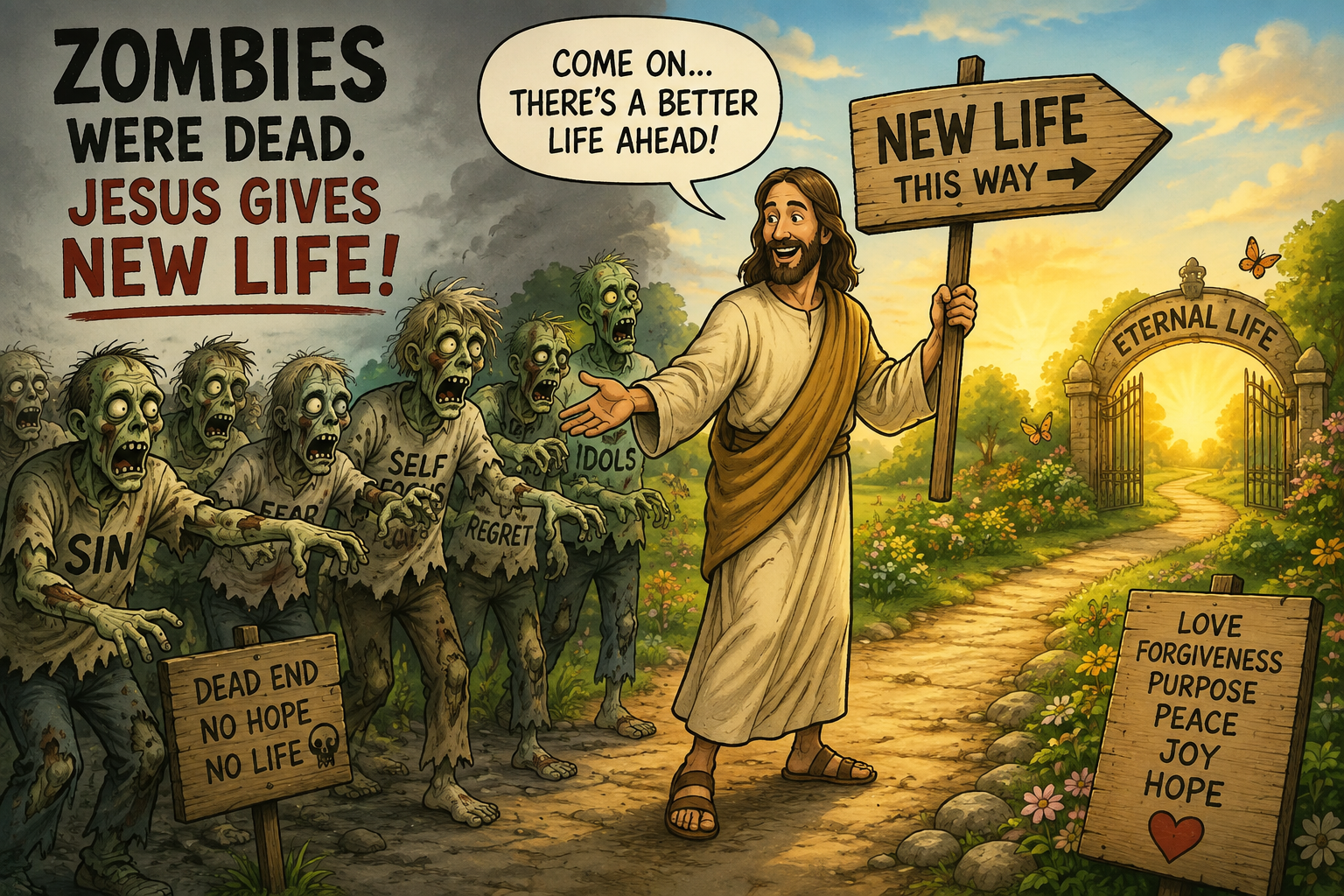
The bad news: the zombie apocalypse has already happened.
The really bad news: we are the zombies. We never escaped.
The good news: there is a way out.
I love zombie movies, though I am a little embarrassed to admit it. I was thinking about all the names we give the living dead—the walking dead, the undead, flesh-eaters, night walkers, and a whole collection of other unpleasant creatures—when I noticed something strange.
The imagery sounded remarkably similar to some of the Bible’s descriptions of fallen humanity: dead, enslaved, under sin, hostile to God, in the flesh, under wrath, and alienated from God.
Ouch.
That led me to wonder what would happen if we explained the Christian idea of being “born again” through the imagery of a zombie movie.
Three questions will guide us through this apocalypse:
1. How did this happen, and why am I included?
2. What condition has this catastrophe left us in?
3. How can a zombie possibly escape?
How Did the Zombie Apocalypse Happen?
The story begins a long, long time ago, but not in some galaxy far, far away. It begins right here. We are standing on ground zero.
Genesis tells us that God created the world, humanity, and the cosmos, and when creation was complete, God declared it “very good.” Adam and Eve lived in the Garden of Eden in a relationship with God and with creation as life was intended to be lived.
There were no zombies yet.
The full story is found in Genesis 1–3. What follows is only the short version.
One Rule, One Rebellion
God gave Adam and Eve one prohibition in the Garden: they were not to eat from the tree of the knowledge of good and evil.
The question was fundamentally one of trust. Would they trust God when he told them what was good for them?
Then the serpent entered the story.
We do not know how long the temptation continued before Adam and Eve finally ate the fruit. Maybe the serpent could have accomplished the whole thing today with a fifteen-second TikTok video or a carefully targeted Instagram advertisement. Or perhaps the temptation worked on them for a very long time.
Either way, eventually they trusted the serpent rather than God.
God had warned them that if they ate from the tree, they would surely die.
They ate.
Adam and Eve did not immediately fall over physically dead. They remained alive, breathing, thinking, and walking around. But something had died.
Their relationship with God was broken. Spiritual death had entered human existence, and physical death would now follow with certainty. Adam and Eve had become something resembling the walking dead: physically alive, but spiritually separated from the God who is the source of life.
Or, using our movie terminology, humanity had produced its first zombies.
Why Am I Included in Their Disaster?
Unfortunately, the catastrophe did not stop with Adam and Eve. Their rebellion affected the human race that came after them and the creation in which humanity lives. Death became part of the human condition. Generation after generation was born into the same damaged world and the same separation from God.
In modern imagery, it is as if someone pressed the enormous red button marked DO NOT PRESS and then discovered that the button affected everyone.
In Greek mythology, Pandora opened the box and evil escaped into the world. Humanity has told stories like this for ages because something about the world obviously seems wrong.
But Genesis gives us an uncomfortable answer about who caused the human catastrophe.
We did.
Humanity wanted independence from God, and humanity got it—with consequences nobody could control.
But I Don’t Feel Dead
“But I don’t feel dead.”
Of course not. Zombies don’t know they’re dead either. Fish don’t know they live in water.
Human beings often have difficulty perceiving conditions that surround us continuously. If spiritual death means that we have become insensitive to part of reality, then we should not expect spiritual death to announce itself with a warning light on the dashboard.
For most of human history, people breathed air without understanding atmospheres, oxygen, pressure, or the chemistry involved. The reality existed whether they understood it or not. Likewise, if humanity has been born into a spiritually damaged condition for generation after generation, that condition feels normal to us.
We are zombies born among zombies.
Echoes of Paradise
Yet even though humanity really messed things up, something strange remains in us.
We seem to carry an echo of things lost: life with God, paradise, immortality, wholeness, and life as it was supposed to be lived. Human beings across cultures long for life, meaning, beauty, goodness, permanence, and something beyond death.
Genesis says we were created in the image of God. Although humanity became spiritually dead through Adam and Eve, something remains—a reflection, a shimmer, a reminder of what we were created to be.
We long for paradise because, in a sense, paradise is part of our oldest family memory.
God made us for himself.
And God did not abandon us.
We Still Want the Driver’s Seat
The rub is that we want to run our lives in our own way, without the outside influence of God. We want control.
We want to be captains of our own souls, masters of our own fate, lords of our own little kingdoms, and judges of what is right and wrong. We sit in the driver’s seat and resist anyone else taking the wheel.
And when we do make room in our hearts for something greater than ourselves, we have a remarkable tendency to put almost anything there except God: our heroes, nature, political causes, admired leaders, our own intelligence, our feelings, our certitude, or our conviction that we are righteous and everyone else is wrong.
We make idols out of the things we trust, admire, fear, or believe will save us, and they quietly take the place that belongs to God.
Given our history of rebellion, surrendering that control and learning to trust God does not come naturally.
A Zombie Cannot Rescue Himself
Here lies the great problem: if the zombies are the problem, the zombies cannot also be the ultimate solution.
We cannot reverse spiritual death by trying harder, accumulating more information, becoming more respectable, or developing a better self-improvement program. If everything depended upon us, this story would have no happy ending.
I once watched a Disney movie in which a family was hit by one disaster after another. The father lost his job, the family faced eviction, Christmas was approaching, and almost nothing seemed capable of fixing the situation. I kept wondering, “Where is the happy part?”
Because it was Disney, a happy ending eventually arrived.
Our situation is much more serious.
Fortunately, our story does not depend upon the zombies figuring out their own escape.
God Makes the Way Out
The biblical story began with God, not with us.
God created life. God created humanity. God created the Garden. And after humanity wrecked the situation, God did not abandon his creation.
Nothing Adam and Eve did, nothing we have done, and nothing the serpent has done has overturned God’s purposes. God loves us and wants us reconciled to him rather than permanently trapped in our zombie existence.
The escape from the apocalypse therefore begins with God, not with us.
Jesus Says We Must Be Born Again
The Gospel of John brings the solution into sharp focus.
John tells us that Jesus came into the world he had made. Many rejected him, but those who received him and believed in his name were given the right to become children of God.
John then tells of a conversation between Jesus and a prominent Jewish leader named Nicodemus. Jesus does not tell Nicodemus that he merely needs a little spiritual improvement.
He tells him:
“You must be born again.”
That is a radically different diagnosis.
The zombie does not need rehabilitation.
The zombie needs life.
Becoming Children of God
John 1 explains this new life using the language of becoming children of God. Those who receive Christ and believe in his name are given the right to become God’s children.
That is an extraordinary promise.
We Americans are very fond of rights. We talk about constitutional rights, civil rights, human rights, and the inalienable rights described in the Declaration of Independence.
But John describes a right no government can grant: the right to become a child of God.
And John immediately explains where this new birth comes from. It does not arise from bloodline, human effort, physical desire, or human decision alone.
It comes from God.
The zombies do not manufacture the new life.
God gives it.
Believing Is More Than Clicking “Agree”
John says that those who believe in Jesus have eternal life. But the word “believe” can sound rather weak to modern ears.
Today we might say, “I saw that on TikTok,” “I read something about it on Instagram,” or “That sounds right, so I guess I believe it.”
Modern casual belief can mean little more than encountering an idea, finding it plausible, mentally clicking AGREE, and then moving on to the next item in the news feed.
Believing in Jesus, as John presents it, is much deeper. It is closer to saying:
I have encountered a Person. I accept his testimony as true. I entrust myself to him. I receive him for who he is. And I now live in continuing dependence upon him.
That is a very large difference.
New Birth Is Not a Zombie Antidote
Jesus does not hand us an anti-zombie injection that repairs our old condition and sends us happily back on our way.
The old zombie life is still headed toward death. This body is dying. Nothing will prevent it from eventually returning to dust.
New birth is therefore not merely recovery. It is not spiritual medicine that restores the old zombie to perfect health.
It is the beginning of a genuinely new life.
That distinction is important enough that I need to borrow one more ridiculous movie analogy.
Turning the Alien Movie Backward
Please forgive me for one more movie motif.
Some alien movies show an evil creature stabbing a human and implanting a tiny alien egg or organism inside. The human becomes a host while the alien grows within. Eventually, the creature emerges and destroys the host.
Now turn the whole story backward.
Think of us as the zombies: dead flesh, with bodies ultimately headed toward the grave and dust.
Then something comes from outside us.
God gives new life.
Instead of an evil alien implanting something that destroys life, the loving, righteous, holy Creator gives something that produces life.
The new seed does not feed upon us as a parasite. It grows within the dust of the old zombie existence like the seed of a new plant. A new being begins to grow—the kind of human being we were meant to become.
It is an imperfect analogy.
But imperfect analogies sometimes help zombies understand things.
The New Life Begins to Grow
The Christian life is therefore a strange reversal of the alien movie.
God gives life, and God’s Spirit nurtures that life as it grows. The old zombie existence does not instantly disappear. We still live in these mortal bodies. We still struggle. There is pain. There are troubles. There may be persecution. There are failures.
But there is also help, joy, growth, forgiveness, hope, and increasing closeness to God.
We begin walking with God.
If the image helps, think of the Christian life as beginning the long walk back toward the Garden—back toward paradise, back toward life, and back toward the face-to-face relationship with God for which humanity was created.
We are not there yet.
But we are headed home.
Paul and the Struggle With the Zombie Body
The Apostle Paul describes the struggle with sin in language that fits our zombie imagery remarkably well.
In Romans 7:15–25, Paul describes wanting to do what is right yet finding himself doing the very things he hates. He wants the good but encounters sin working within him.
Eventually he cries:
“Wretched man that I am! Who will deliver me from this body of death?”
And then comes the answer:
“Thanks be to God through Jesus Christ our Lord!”
I find that passage deeply encouraging. Christian life does not mean that every old struggle instantly disappears. The new life grows while we still drag around this old mortal body and confront habits, temptations, fears, and sins that belong to the old existence.
The struggle itself reminds us how desperately we continue to need Christ.
The Zombie Dies, but the New Life Does Not
Physical death eventually wins its battle against the zombie body.
This body returns to dust.
But according to God’s promise, the life God begins through the new birth does not end at the grave. God promises eternal life to those who believe in Jesus.
The old mortal shell has an expiration date.
The new life does not.
So death becomes something very different for the Christian. It remains real, painful, and serious, but it is no longer the final word.
The zombie body dies.
The life God gives continues.
My Zombie Story Is Still in Progress
My personal story is still in progress.
I still live in one of these mortal zombie bodies, and like other Christians, I stumble along with it still in tow. But I also believe God has given me new life.
Every day I pray that Jesus will walk with me, help that new life grow, and make me more like him. I enjoy closeness to Jesus here and now. At the same time, I look forward to the day when this old shell finally falls away and I stand before him in glory, fully alive and finally becoming everything God intended me to be.
Until then, the zombie story continues.
But it is no longer a story without hope.
A Note About This Article
This article has been a collaborative effort between the author and ChatGPT. The author provided the original ideas, theological reflections, personal experiences, analogies, humor, and direction. ChatGPT assisted with discussion, research, organization, editing, consolidation, and turning the author’s Semantic Knowledge Mapping nodes into the finished article. The author remains responsible for the article’s final content, conclusions, and publication.