Three Asset Questions and Preventing Envy (Psalm 73)
Published
When Someone Else Seems to Have It Easy
When the grocery bill goes up again, most of us can name something we’ll have to do without. Then we hear about a neighbor’s vacation. A moment ago we were thinking about the price of eggs. Now we’re wondering why life seems so easy for him. That little turn from concern to comparison is where envy enters the picture.
Asaph, the man who wrote Psalm 73, had a harder question. He believed God was good, yet he saw arrogant people prosper and began to wonder what good it had done him to keep his own heart pure. Listen to how quickly he goes from a confession of faith to a confession of envy.
Psalm 73:1–5 (English Standard Version)
A Psalm of Asaph.
1. Truly God is good to Israel, to those who are pure in heart.
2. But as for me, my feet had almost stumbled, my steps had nearly slipped.
3. For I was envious of the arrogant when I saw the prosperity of the wicked.
4. For they have no pangs until death; their bodies are fat and sleek.
5. They are not in trouble as others are; they are not stricken like the rest of mankind.
What troubles Asaph is how close he came to letting those men decide what kind of life was worth living. Later in the psalm, when he enters God’s sanctuary, he begins to see their lives in light of their end (verses 16–17). By verse 28, he can say what he wants for himself: to be near God.
Suppose I’m standing in my driveway admiring my neighbor’s new car. The moment I decide I need one like it, I’ve already let his purchase set the terms of a decision about mine. Meanwhile, the car I own gets me to work and lets me take a friend to the doctor. Envy makes it surprisingly easy to overlook those two perfectly good uses of an old car.
That gives me a place to begin when rising prices leave me feeling squeezed. I can look at what’s already in my hands and ask what I can do with it.
The Production Mindset
By a production mindset, I mean the habit of asking, “What does this item, skill, or habit allow me to do?” I’m using production in an everyday sense. A pot of soup can feed a family. Knowing how to mend a coat can give someone another winter’s wear. An extra chair at the table lets us offer a lonely neighbor supper. Each produces something worth having, even when no money changes hands.
The Three Asset Questions
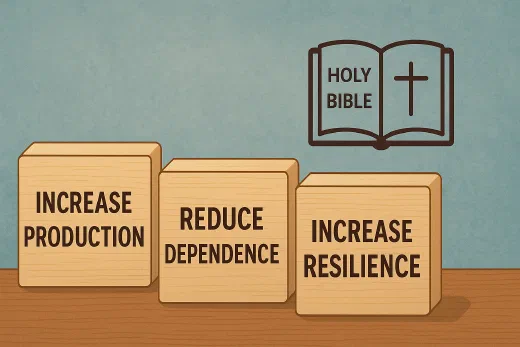
Here are three questions I can ask about something I already own or am thinking of buying.
- Does it increase my ability to produce? A sewing machine gives me a way to mend that coat, provided I learn to use it. If there’s already one in the closet, an afternoon with someone who sews might do me more good than a newer machine.
- Does it reduce my dependence on fragile systems? Learning one repair I can do at home gives me a choice the next time something breaks. I can still take a difficult job to a professional. For the simple job, I have another option when money is tight or the shop is booked.
- Does it increase my resilience to stress or disruption? Think about a week when illness keeps us home. A pantry stocked with a few meals we actually eat gives us time to recover. So does having a friend we can call, especially if we’ve made a habit of showing up for one another.
A purchase can meet one of these needs and still cost more than my household can afford. And some things are worth buying simply for the pleasure they bring. These questions help me be honest about what I expect a purchase to do.
When Envy Creeps Back In
Suppose my neighbor comes home from that vacation with a story to tell. I’d like to be able to enjoy it with him. If I have to convince myself he went into debt or had a miserable time before I can feel content, his good fortune still has too much say over my life.
Asaph’s change of heart came in God’s sanctuary. The three questions belong to a smaller, everyday decision. When I catch myself comparing, they give me something better to do with my attention. Is there something in this house I could put to use? Something I know how to do that would make this week easier for someone else?
Maybe the answer is as ordinary as giving that friend a ride to the doctor. I started out wishing I had my neighbor’s car. I’d rather end the day grateful for the one that got us there.
References
Pugsley, John A. The Alpha Strategy: The Ultimate Plan of Financial Self-Defense. 2nd ed. Los Angeles: Stratford Press, 1981.
Creation and AI Assistance Statement
This article resulted from the author’s research and lengthy conversations with ChatGPT (OpenAI). ChatGPT generated the final article from a mass of resource materials. Grammarly cleaned up the wording. The author performed the final review and editing before posting.