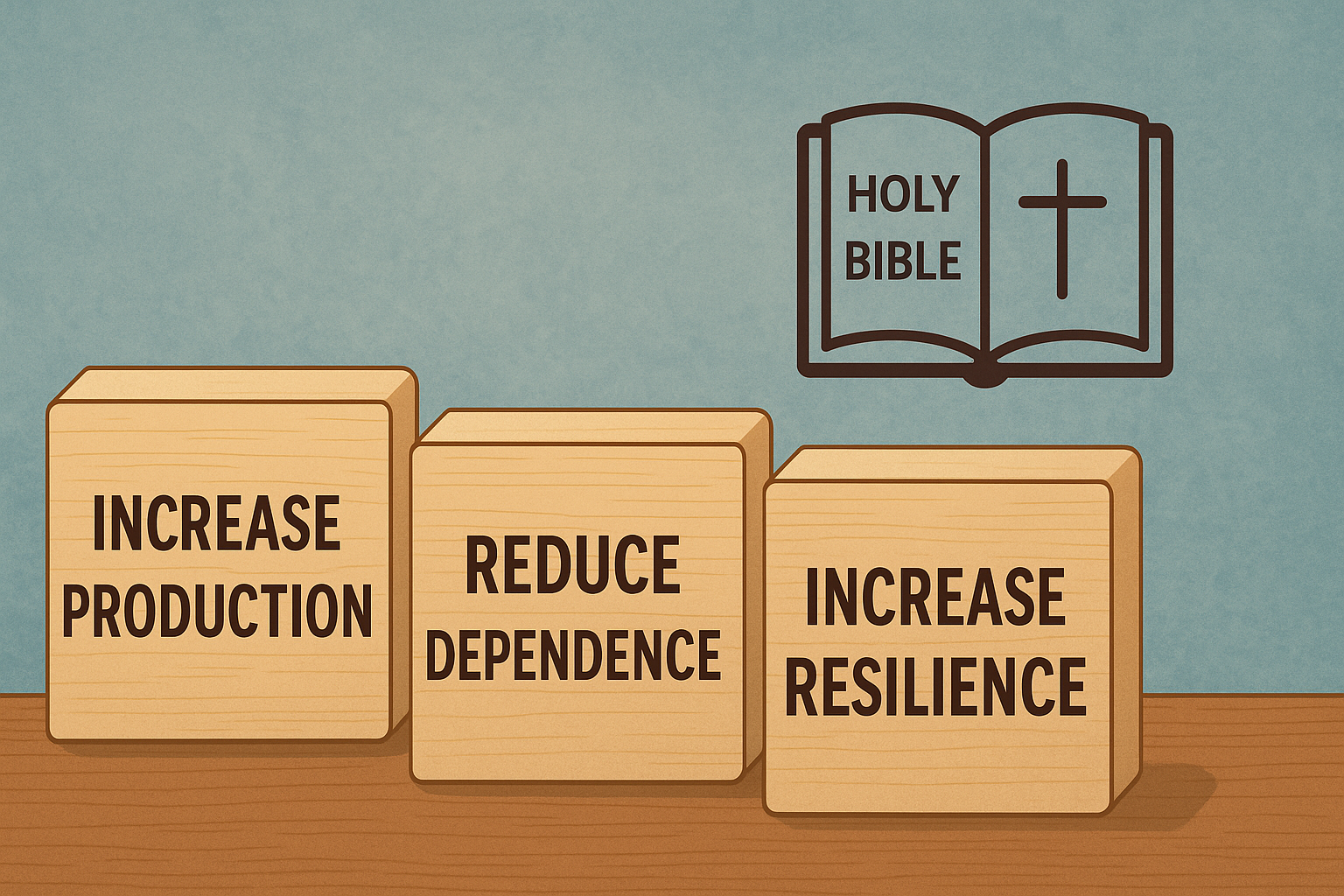
Overcoming Envy with Three Asset Questions
It is easy to look at others’ prosperity and feel a twist in our gut. Psalm 73 captures this truth honestly. The psalmist nearly lost his footing because he envied the success of people whose lives looked effortless and luxurious. Their smooth path, large houses, and apparent peace made him wonder whether he had chosen the right way of life at all.
Our modern world does not look very different. Some people appear to live effortlessly at a high standard of living, flowing from one pleasure to another, surrounded by conveniences, comforts, and new possessions. It is tempting to interpret this as a strength. But the key question is not what someone owns, but what their assets actually do.
This is where a production mindset comes in.
The Production Mindset
Before discussing assets, we need a simple definition of the production mindset. A person with a production mindset evaluates resources not by their price or appearance, but by their usefulness. Earlier articles explained that long-term resilience does not come from the quantity of possessions but from the ability to produce value: food, repair work, hospitality, stability, community, insight, or service.
A high standard of living built only on consumption is fragile. A modest standard of living built on steady production and capability is far stronger. The production mindset is simply the habit of asking, “What does this item, skill, or habit allow me to do?”
The Three Asset Questions
When evaluating an asset, it is helpful to ask three questions. These questions help separate true assets from consumption disguised as strength.
- Does it increase my ability to produce? If something expands your ability to create, repair, build, teach, or serve, it supports your long-term strength. A tool you know how to use, a skill you practice regularly, or habits that make you more capable all fall into this category.
- Does it reduce my dependence on fragile systems? When something reduces your reliance on supply chains, debt, subscriptions, or the constant flow of services, it increases stability. Dependence is not inherently wrong, but excessive dependence creates fragility. Anything that lowers unnecessary dependence strengthens your life.
- Does it increase my resilience to stress or disruption? Resilience is your ability to function well when conditions are difficult. Some investments increase your resilience: basic skills, a small pantry, a habit of repairing instead of replacing, a calm mind, and strong relationships. A resilient household can absorb more shocks with less damage.
These questions are simple, but they reveal the true nature of an expenditure. Almost anything can be turned into an asset if used wisely. Almost anything can become a liability if used for show, comparison, or personal inflation.
Preventing Envy Through Discernment
Envy grows in the absence of understanding. The psalmist in Psalm 73 envied the wicked because he saw their comfort but not their foundation. He saw their outward success but not their inward fragility.
Asking the three asset questions dissolves envy by training your eyes to look beneath the surface. When you evaluate others’ possessions and lifestyles by their function rather than their appearance, things become clearer:
- Some people with impressive homes are drowning in debt or fear.
- Some people with expensive vacations are escaping emptiness, not growing stronger.
- Some people with new cars and gadgets are one paycheck away from collapse.
- Some households with modest incomes quietly maintain deep resilience, wisdom, and peace.
The point is not to judge others, but to see reality more clearly and avoid slipping into envy, as Psalm 73 warns. It helps you distinguish between appearance and substance.
What the Three Questions Teach Us
When used consistently, these questions help us learn:
- Not to envy lifestyles built entirely on consumption.
- To value capability over appearance.
- To recognize that almost any possession can be used for good if infused with purpose.
- To see that resilience is a form of wealth no one can take away.
- That wisdom is the foundation for a life that endures hardship.
- A person’s visible lifestyle rarely reveals their true strength.
Psalm 73 teaches us not to envy the wicked or those who prosper without wisdom. The three asset questions provide practical tools for understanding why. They help us see life as it truly is: strength is not measured by the height of someone’s consumption, but by the depth of their resilience and the fruitfulness of their life.
References
Pugsley, John A. The Alpha Strategy: The Ultimate Plan of Financial Self-Defense. 2nd ed. Los Angeles: Stratford Press, 1981.
Creation Statement
This article is the result of multiple collaborative sessions between the author and ChatGPT while exploring concepts from The Alpha Strategy and related topics. ChatGPT produced the initial draft based on those discussions. The draft was then reviewed and refined by the author and further proofread by the author’s wife, who holds an M.S. in English Literature. Additional minor edits were made using Grammarly for readability.